
Review · PARIS
Area ,Opera, Jewellery,Fashion,Palais Royal walking tour
Paris’s luxury quarter is more than a parade of expensive shop windows. This walk links Palais Royal, Rue Saint-Honoré, Place Vendôme, and Palais Garnier with stories about French theater, fashion, jewelry, perfume, and imperial Paris.
I like the tiny group, limited to five people, because you can ask Neda for personal suggestions without shouting across a crowd. I also like the route’s mix of grand monuments and everyday city details, from Molière at the Comédie-Française to perfume bottles at Fragonard.
The main catch is focus. This is an outdoor walking tour about fashion, jewelry, culture, and architecture, not a full guided visit inside the Opera. The Palais Garnier interior costs an additional 14 euros, and one past participant found the commentary too brief and hard to hear.
Key points to know before booking
- A compact Right Bank route: Walk from Palais Royal to Opéra Garnier in about two hours and ten minutes.
- Neda leads the experience: Her style is described as friendly, funny, personal, and full of stories about Parisian fashion and business.
- A true small-group walk: The maximum group size is five, giving you a better chance to ask questions.
- Fashion and jewelry are central themes: Rue Saint-Honoré and Place Vendôme are as important as the monuments.
- The Opera interior costs extra: The tour ends at Palais Garnier, but entry inside is not included.
- A useful first-day orientation: Ask for restaurant, shopping, and sightseeing suggestions while you walk.
Paris luxury begins at Palais Royal
The meeting point is Le Nemours, at 2 Place Colette, beside the Palais Royal area. The walk starts at 10:00 in the morning and ends at Palais Garnier in the ninth arrondissement.
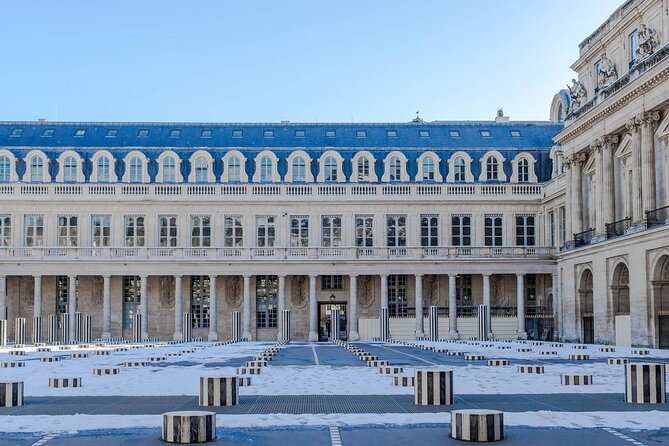
That opening location is smart. Palais Royal sits close to the Louvre, but its arcades and garden offer a quieter start than the museum’s crowded forecourt. The palace was ordered by Cardinal Richelieu in 1633, when he wanted to remain close to the king’s residence at the Louvre. That detail sets up one of the tour’s recurring ideas: Paris’s grand buildings often began as places of power before becoming public spaces, cultural venues, or luxury addresses.
You spend about 20 minutes in the Jardin du Palais Royal. The garden is surrounded by government and cultural buildings, including the Constitutional Council, the Ministry of Culture and Communication, the Comédie-Française, and the Théâtre du Palais Royal. It is a compact place, but it gives you a useful sense of how many layers of Paris can occupy one city block.
I would pay close attention here to the transition from formal architecture to modern life. The garden is not simply a pretty pause. It helps explain why this part of Paris became a meeting ground for politics, theater, shopping, and public life.
Other concerts and shows we rate around Paris
- Paris: 3-Course-Dinner Cruise on the Seine with live music
★ 4.7 · 7,248 reviews - Paris: 4-Course Dinner Cruise on Seine River with Live Music
★ 4.5 · 3,827 reviews - Paris: Gourmet Dinner Cruise on Seine River with Live Music
★ 4.5 · 2,531 reviews
Molière and the Comédie-Française
The stop at the Comédie-Française lasts about five minutes, so expect an exterior explanation rather than a theater visit. The subject is Molière, whose plays have been translated into major living languages and are performed at the Comédie-Française more often than those of any other playwright.
That short stop has real value if you enjoy French theater or want a little cultural context before seeing the grander parts of Paris. The Comédie-Française is the oldest active theater company in the world, and its reputation gives the street a special weight.
Still, keep your expectations measured. Five minutes is enough for a pointed story and a look at the building, not a full lesson in Molière or a tour of the auditorium. If theater is your main reason for booking, you may want to add a separate visit or performance.
Rue Saint-Honoré, where fashion becomes the main subject
The walk then follows Rue Saint-Honoré for around 25 minutes. At roughly 1,840 meters long, the street links central Paris with the prestigious eighth arrondissement. Its stone façades and Haussmann-era architecture provide the setting, but the real topic here is the concentration of luxury shops, fashion houses, and artistic businesses.
This is where the tour’s title becomes important. You are not just being led from one historic building to another. Neda’s commentary centers on the personality of Parisian fashion, luxury business, and the people and ideas behind the displays. One of the strongest features of this walk is the chance to look at the street as a working commercial district rather than merely as a shopping zone.
You do not need to buy anything to enjoy this section. The pleasure comes from seeing how the boutiques fit into the older city, with polished windows set against traditional stone buildings. If you are interested in design, branding, jewelry, or the social side of luxury, this may be the most useful stretch of the route.
There is also a practical benefit. This is a good moment to ask Neda for suggestions about shops, nearby sights, and places to explore later. The tour is short enough that personal questions can shape the experience, especially with no more than five people in the group.
Saint-Roch and the layers of Parisian architecture

The Church of Saint-Roch receives about 15 minutes. At 126 meters long, it is one of Paris’s largest churches, with a plan inspired by Notre-Dame de Paris.
Saint-Roch took many decades to build, and that long construction period is visible in its mixture of classical and baroque styles. This makes it a useful stop for reading Paris architecture. You can see how a single church may contain more than one period, rather than fitting neatly into one style.
The church also gives the walk a needed change of pace. After the polished shops of Rue Saint-Honoré, Saint-Roch brings you back to religious architecture and public history. The tour does not list an included interior visit, so treat this as a guided stop around the church and an explanation of its importance.
For you, the main value is comparison. The route places fashion, theater, religion, and royal power within a short walk. That variety helps make the Opéra district easier to understand than a tour focused only on one grand building.
Same city, a different kind of sound:
- Bateaux Mouches Dinner Cruise on the Seine River in Paris
★ 4.5 · 4,847 reviews - Paris: Opera Garnier and Seine River Cruise Tickets
★ 4.5 · 957 reviews - Paris: Classical Music Concert in Saint-Julien-le-Pauvre
★ 4.8 · 791 reviews - Paris: Seine River Cruise with 3-Course Dinner & Live Music
★ 4.5 · 570 reviews
Place Vendôme and the jewelry quarter
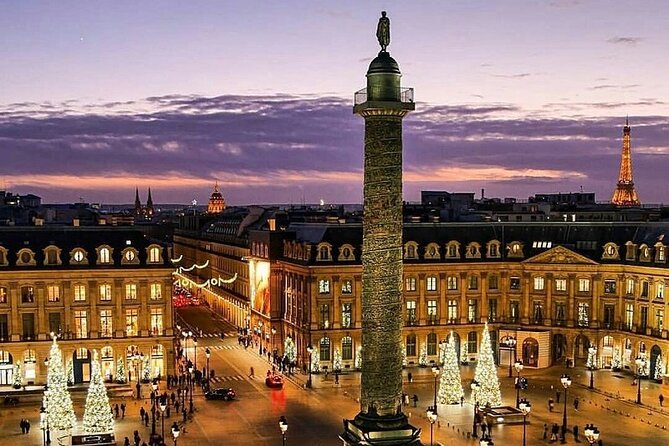
Place Vendôme receives about 20 minutes, and it is one of the clearest stops for the jewelry theme. The square was laid out in 1702 as a monument to the armies of Louis XIV, the Sun King. Its later Vendôme Column was modeled on Trajan’s Column in Rome and commemorated Napoleon Bonaparte’s victory at Austerlitz in 1805.
Today, the square is closely linked with luxury jewelry. The setting is formal and imposing, with grand façades framing the boutiques. Neda’s explanations connect the square’s military and imperial past with its modern role in high-end retail.
I like this stop because the contrast is so sharp. Place Vendôme was built to project state power. Now it also projects the power of brands, craftsmanship, precious materials, and status. You can understand the square better when you see both sides.
This is not a jewelry-making workshop, and the tour does not promise access to private ateliers. You are mainly learning how the district developed and why this address carries such weight in the world of luxury goods. If your interest is fashion history or jewelry culture, the context is more valuable than a simple list of famous names.
Palais Garnier, Paris in grand theatrical form
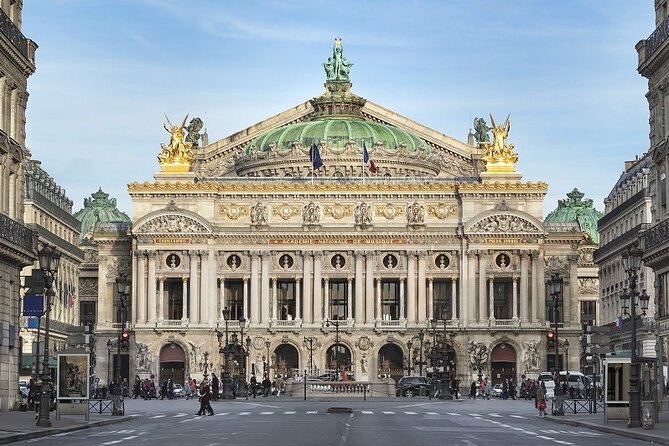
The route continues to Palais Garnier for about 25 minutes. Emperor Napoleon III commissioned the Opera as part of his reconstruction of Paris, and a design competition for the new opera house was held in 1860.
The building became a major center for opera and ballet. Even from outside, its scale and decoration make clear that this was meant to be more than a practical performance hall. It was built to announce the ambition of the Second Empire and the changing face of Paris.
This is the final stop and the tour’s natural high point. The earlier subjects come together here: fashion, architecture, theater, business, and public display. The Opera sits at the center of the district’s polished image, but its story also connects to the city’s political and urban changes.
There is an important cost detail. Entry inside Palais Garnier is not included. A separate visit costs 14 euros. If you want to see the grand interior, add that expense and allow extra time beyond the scheduled walk.
The tour itself is designed as an exterior and cultural overview. One past participant felt that too little was said at the Opera and that the guide could be difficult to hear. That criticism is worth taking seriously. In a group, stay close to Neda and speak up if you miss a point. The small group should help, but good positioning still matters.
Perfume history at the Fragonard museum
The final listed stop is the Musée du Parfum, operated by Fragonard, near Palais Garnier. You spend about 15 minutes learning about perfume production and the place of fragrance in French luxury culture.
The collection covers perfume containers from ancient Egypt through the twentieth century. Objects include kohl pots, pomanders, vinaigrettes, perfume burners, pot-pourris, travel sets, smelling-salt bottles, and ornate flasks.
This is a pleasant ending because it adds scent to a walk that has mostly focused on buildings, streets, and shopfronts. Perfume is an everyday item, but the museum shows how much design, ritual, and craftsmanship can sit behind it.
Fifteen minutes is not enough for a long museum visit. Think of this as a focused introduction rather than a full tour of the collection. The museum is close to the Opera, so you can decide later if you want to return for more time.
What the small group changes
The maximum group size is five. That is a meaningful advantage in a district where the best explanations often come from questions. You can ask about a shop window, a building detail, French fashion, the Opera, or what to see next without turning the walk into a public speaking exercise.
Neda is described as friendly, funny, helpful, and easy to follow. Her strongest quality appears to be the ability to give the district a personal angle, especially when discussing fashion, business, architecture, and modern Paris.
The experience depends on communication. One person found the tour dull because the guide did not always stop for the full group and could not always be heard. That does not erase the many positive descriptions of Neda’s energy and subject knowledge, but it does suggest a useful tactic: remain near the guide, ask questions directly, and say so if you cannot hear.
The walk is also better suited to people who enjoy conversation than to those seeking a tightly scripted monument tour. You get an overview and a chance to shape the discussion. That can be rewarding, but it means the exact balance between history, fashion, shopping, and architecture may vary.
Price, timing, and who gets good value
The price is $74.49 per person for about two hours and ten minutes. That is not cheap for a walking tour, so value depends on what you want from the morning.
You are paying for a small group, a specialist theme, and a route connecting several major Paris addresses. A large group walk may cost less, but it will rarely offer the same chance to ask Neda for local suggestions or discuss a particular interest.
I see the price as easier to justify if you care about fashion, jewelry, perfume, or Parisian architecture. It is less attractive if your only goal is to enter Palais Garnier, since admission is separate and the Opera interior is not part of the included experience.
The tour is booked around 58 days in advance on average, so do not assume you can leave it until the last morning of your trip. It is offered in English, uses a mobile ticket, and starts at 10:00. The route is near public transportation, and most people can take part.
Free cancellation is available up to 24 hours before the start time. Changes or cancellations inside that window are not accepted for a refund.
Who should book this walk
I would choose this tour if you want a compact introduction to the Right Bank and prefer a guide who can connect the sights to modern Paris. It suits first-time visitors who want to understand the Opéra area before exploring it on their own.
It is also a good fit for anyone interested in:
- French fashion and luxury retail
- Jewelry and Place Vendôme
- Perfume and the history of fragrance
- Parisian theater and Molière
- Grand nineteenth-century architecture
- Small groups and personal questions
I would be more cautious if you want long interior visits, detailed art history, or a formal lecture at every stop. Several stops are brief, and the Opera visit is not included. You should also be comfortable walking between locations and spending much of the experience outdoors.
Should you book the Palais Royal to Opéra walk?
Book it if you want to see how fashion, jewelry, theater, perfume, and power share one small section of Paris. The route is well chosen, Neda brings a personal touch, and the five-person limit gives the tour a more relaxed feel than a standard city walk.
Skip it if your priority is entering Palais Garnier or receiving a long, highly structured history lesson. In that case, use this walk as an exterior introduction and arrange a separate Opera visit.
For most visitors, the best plan is to take the walk in the morning, stay close enough to hear clearly, ask Neda for follow-up suggestions, and add the 14-euro Opera admission only if the interior matters to you.
FAQ
How long is the walking tour?
The tour lasts approximately 2 hours and 10 minutes.
Where does the tour start?
It starts at Le Nemours, 2 to 7 Galerie de Nemours, 2 Place Colette, 75001 Paris, France.
Where does the tour end?
The walk ends at Palais Garnier, Place de l’Opéra, 75009 Paris.
What time does the tour begin?
The scheduled start time is 10:00 in the morning.
Is admission to Palais Garnier included?
No. Visiting inside the Opera house costs an additional 14 euros.
How many people can join the tour?
The activity has a maximum of five participants. It is offered in English and uses a mobile ticket.
Just reviewed around Paris
- Create unique jewelry from top Parisian designer Bijoux Blues★ 4.0 · 2 reviews
- Paris Opera Garnier Private Tour★ 5.0 · 42 reviews
- Sunset Picnic with View of Eiffel Tower and Live Music★ 5.0 · 15 reviews
- Opera Garnier with private guide★ 4.5 · 21 reviews
- Private Opera Garnier Theater 2-Hour Tour in Paris★ 5.0 · 45 reviews
- 2 Hour Private Opera Garnier Guided Tour★ 5.0 · 11 reviews
- Opera Garnier Mysteries Private Guided Tour with Skip-the-Line Entrance★ 5.0 · 49 reviews
- Harlem in Paris : the Birth of Jazz in France (Small Group Walking Tour)★ 5.0 · 37 reviews
Paris Live Music: the closest alternatives.
Paris: 3-Course-Dinner Cruise on the Seine with live music
Read our review →
Paris: Gourmet Dinner Cruise on Seine River with Live Music
Read our review →
Paris: Classical Music Concert in Saint-Julien-le-Pauvre
Read our review →
Paris: Classical Music Concert Tickets in Parisian Churches
Read our review →
Admission ticket Arsène Lupine and the secret of the Opera
Read our review →
Paris Seine River Dinner Cruise by Maxim’s with Champagne & Music
Read our review →
Paris: Romantic Piano Concert at Saint-Julien-le-Pauvre
Read our review →
Opera Garnier Mysteries Private Guided Tour with Skip-the-Line Entrance
Read our review →This show also appears in